



Contact For Pricing
Thanks for the request. We'll get back to you with in 24 hours.
Condition: Refurbished ✓ Pulled from working servers & Tested. ✓ 1-year Parts Warranty.
Quick Specs
- RAID Level: 0, 1, 5, 6, 10, 50, and 60
- Non-RAID: Yes
- Cache: No
- PCIe: Gen 5 x16
- Processor: Broadcom RAID-onchip, SAS5132W chipset
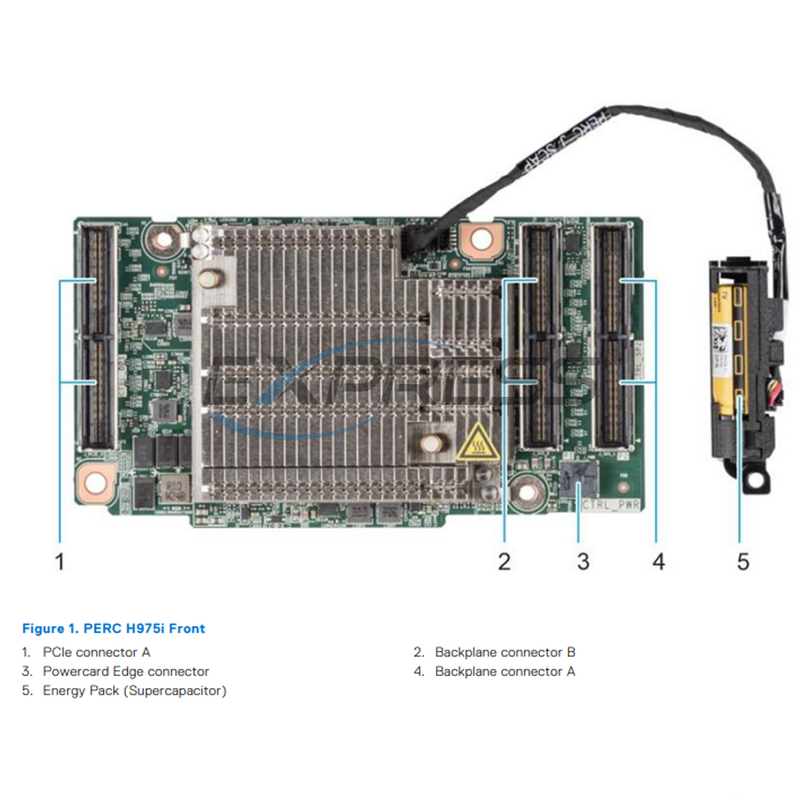
- Battery Backup: Supercapacitor
- Max no of VDs in RAID mode: 16/64
- Max no of disk groups: 32
- Max no of VDs per disk group: 8
- Hot-swap devices supported: Yes
- Drive sector size supported: 512B, 512e, and 4Kn
- Storage Boot Support: UEFI-only
Supported Drives:
- Gen3 (8 GT/s) NVMe
- Gen4 (16 GT/s) NVMe
- Gen5 (32 GT/s) NVMe
- Not supported
- 16 drives per controller
- 32 NVMe
Summary of RAID levels
Summary of RAID levels Following is a list of the RAID levels supported by the PERC 12 series of cards:
- RAID 0 Uses disk striping to provide high data throughput, especially for large files in an environment that requires no data redundancy.
- RAID 1 Uses disk mirroring so that data written to one physical disk is simultaneously written to another physical disk. RAID 1 is good for small databases or other applications that require small capacity and complete data redundancy.
- RAID 5 Uses disk striping and parity data across all physical disks (distributed parity) to provide high data throughput and data redundancy, especially for small random access.
- RAID 6 Is an extension of RAID 5 and uses an additional parity block. RAID 6 uses block-level striping with two parity blocks distributed across all member disks. RAID 6 provides protection against double disk failures, and failures while a single disk is rebuilding. If you are using only one array, deploying RAID 6 is more effective than deploying a hot spare disk.
- RAID 10 Is a combination of RAID 0 and RAID 1, uses disk striping across mirrored disks. It provides high data throughput and complete data redundancy.
- RAID 50 Is a combination of RAID 0 and RAID 5 where a RAID 0 array is striped across RAID 5 elements. RAID 50 requires at least six disks.
- RAID 60 Is a combination of RAID 0 and RAID 6 where a RAID 0 array is striped across RAID 6 elements. RAID 60 requires at least eight disks.
Compatible With:
(Click to View)