


Thanks for the request. We'll get back to you with in 24 hours.
Condition: Refurbished ✓ Pulled from working servers & Tested. ✓ 1-year Parts Warranty.
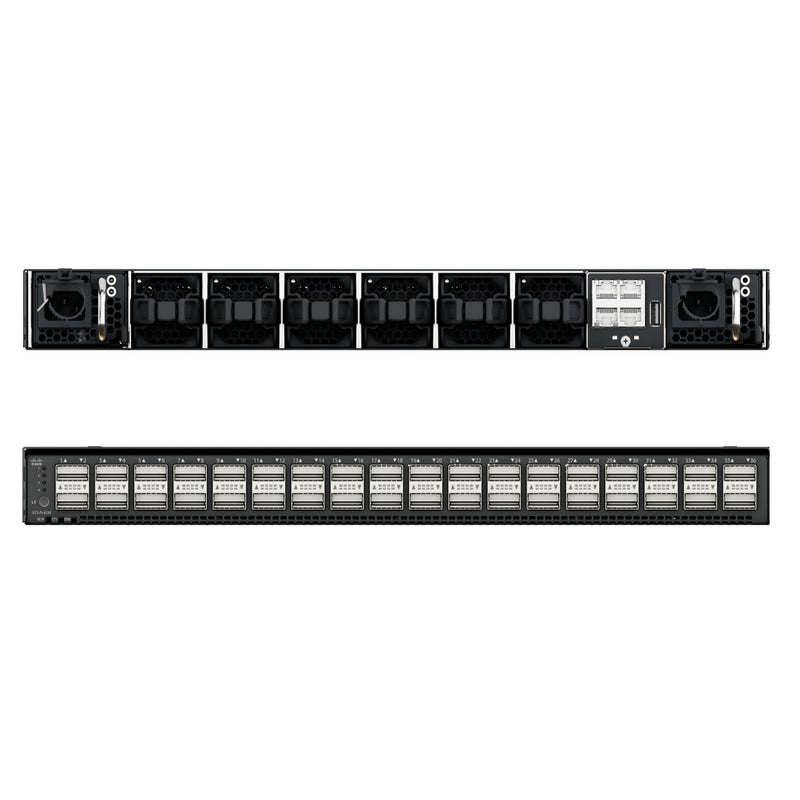
The Cisco UCS 6536 36-Port Fabric Interconnect is a One-Rack-Unit (1RU) 10/25/40/100 Gigabit Ethernet, FCoE, and Fibre Channel switch offering up to 7.42 Tbps throughput and up to 36 ports. The switch has 32 40/100-Gbps Ethernet ports and 4 unified ports that can support 40/100-Gbps Ethernet ports or 16 Fiber Channel ports after break-out at 8/16/32-Gbps FC speeds. The 16 FC ports after breakout can either operate as an FC uplink port or as an FC storage port. The switch supports 2 1-Gbps speed after breakout and all 36 ports can breakout for 10/25-Gbps Ethernet connectivity. All Ethernet ports are capable of supporting FCoE.
The Cisco UCS 6536 Fabric Interconnect also has one network management port, one console port for setting the initial configuration, and one USB port for saving or loading configurations. The FI also includes L1/L2 ports for connecting two fabric interconnects for high availability
The Cisco 6536 Fabric Interconnects are a core part of the Cisco Unified Computing System, providing both network connectivity and management capabilities for the system. The Cisco 6536 offer line-rate, low-latency, lossless 10/25/40/100 Gigabit Ethernet, Fibre Channel over Ethernet (FCoE), and Fibre Channel functions.
The Cisco UCS 6536 Fabric Interconnect provide the management and communication backbone for the Cisco UCS X-Series compute nodes, UCS X9508 X-series chassis, UCS B-Series Blade Servers, UCS 5108 B-Series Server Chassis and UCS C-Series Rack Servers. All servers attached to a Cisco UCS 6536 Fabric Interconnect become part of a single, highly available management domain. In addition, by supporting a unified fabric, Cisco UCS 6536 Fabric Interconnect provides both the LAN and SAN connectivity for all servers within its domain.
| Capability/Feature | Cisco UCS 6536 (36 Ports) |
|---|---|
| Chassis | 1RU 36-port Fabric Interconnect |
| Throughput | 7.42 Tbps switching performance |
| Fan Modules | Six variable speed fans |
| Unified Ports | 4 (33-36) |
| Power Supply | Two Power Supplies (AC or DC) |
| Management by Cisco Intersight | Allows all elements connected to the interconnects to participate in a single, highly available management domain |
| Unified Fabric |
|
| Fabric Extender Architecture |
|
| QSFP28-compatible Ports | Allows all ports to be configured to operate in 40/100 Gigabit Ethernet mode with the transceiver options specified for use with QSFP28-compatible ports |
| Transceivers | The Cisco UCS 6536 series FIs support a wide variety of 10/25/40/100 Gigabit Ethernet connectivity options using Cisco 10/25/40/100 Gbps modules. Unified Ports (UP) on the Cisco UCS 6536 support 10/25/40G/100G Gigabit Ethernet connectivity or a 128G FC-QSFP28 which can breakout into four 8/16/32 Gigabit Fibre Channel connection. Cisco UCS 6536 provides flexible uplink port connectivity at 1G/10G/25G/40G/100G via Gigabit Ethernet transceivers and cables. Table 3 lists the supported transceiver options. |
| Front-to-Back Cooling | Fan side intake, port side exhaust |
| Redundant hot-swappable fans and power supplies |
|
| Rear Ports | Helps keep cable lengths short and efficient |
| Performance |
|
| Lossless Fabric | Provides a reliable, robust foundation for unifying LAN and SAN traffic on a single transport |
| Priority Flow Control (PFC) |
|
| Systemwide Bandwidth Management | Helps enable consistent and coherent quality of service (QoS) throughout the system |