


Condition: Refurbished ✓ Pulled from working servers & Tested. ✓ 1-year Parts Warranty.
-PLEASE CONTACT FOR CUSTOM CONFIGURATIONS. DISK SHELVES, COMPLETE CONFIGURATIONS & TURN KEY SYSTEMS AVAILABLE.
-SPARE PARTS AVAILABLE FOR EACH MODEL. PLEASE ASK FOR PRICING ON SPARE DISK, CONTROLLERS, POWER SUPPLIES, NICs, HBAs, SFPs, Cables, etc.
- Type: Mezzanine
- Ports: 2 Ports
- Plug Type: Internal
- Max Data Rate: 10GBps
- Protocols: Ethernet
- 766490-B21
- 68080-001
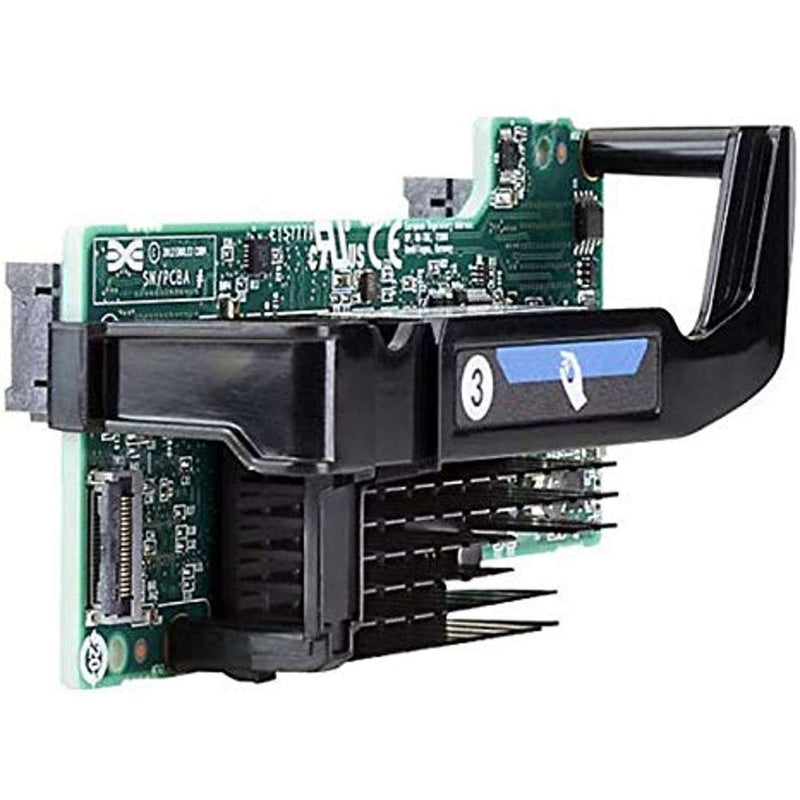
The HPE FlexFabric 10Gb 2-port 536FLB adapter features the next generation of 10 Gb Ethernet offering in a single chip solution on a FlexibleLOM form factor, further reducing power requirements for 2 ports of 10 Gb Ethernet. It is designed for use with HPE BladeSystem c-Class Gen9 servers. It provides full duplex high performance Ethernet connectivity with support for HPE Virtual Connect FlexFabric blade interconnect technology, allowing each 10GbE port to be divided into four physical NICs and optimize bandwidth management for virtualized servers. The HPE 536FLB FlexFabric network adapter, in conjunction with HPE Virtual Connect FlexFabric technology, helps to extend the benefits of virtualization beyond the server and into the rest of the infrastructure.
The HPE 536FLB supports enterprise class features such as VLAN tagging, adaptive interrupt coalescing, MSI-X, NIC teaming (bonding), Tunnel offload (NVGRE,VXLAN) Receive Side Scaling (RSS), jumbo frames and PXE boot. It also supports virtualization features such as SR-IOV, VMware NetQueue and Microsoft VMQ.
- Full hardware offload of iSCSI and FCoE storage protocol processing for highest performance converged Ethernet data and storage networks.
- Dual-port 10GbE Flex-10 FlexibleLOM network adapter that provides the flexibility to choose the type of LOM to meet growing infrastructure needs
- Hardware acceleration and offloads for stateless TCP/IP
- Industry-leading throughput and latency performance
- Up to 40Gb/s bi-directional near line rate throughput
- Improved small packet performance
- Support for Tunnel Offload (NVGRE, VxLAN)
- Integrated PHY and MAC
- Support for Preboot eXecution Environment (PXE)
- Data Plane Development Kit (DPDK)
- IEEE 1588 Precision Time Protocol (PTP)
- Data Rate Two ports, each at 20 Gb/s bi-directional; 40 Gb/s aggregate bi-directional theoretical bandwidth.
- Onboard Memory 900 MB (distributed memory)
- Bus type PCI Express 3.0 (Gen3) x8
This adapter on each server blade connects to a 10 Gb interconnect in bays 1-2 (HPE BladeSystem c7000 Enclosure) or bay 1 (HPE BladeSystem c3000 Enclosure).
This adapter supports linking at 1000 Mbps or 10000 Mbps when not connected to a Flex-10 device.
This adapter will only support 1000 Mbps when connected to a 1 Gb Ethernet interconnect.
This adapter delivers 20 Gb/s bi-directional Ethernet transfer rate per port (40 Gb/s per adapter), providing the network performance needed to improve response times and alleviate bottlenecks.
This adapter supports accelerated iSCSI or iSCSI boot and FCoE.
For overall improved system response, this adapter supports standard TCP/IP offloading techniques including: TCP/IP, UDP checksum offload (TCO) moves the TCP and IP checksum offloading from the CPU to the network adapter. Large send offload (LSO) or TCP segmentation offload (TSO) allows the TCP segmentation to be handled by the adapter rather than the CPU.
(Click to View)